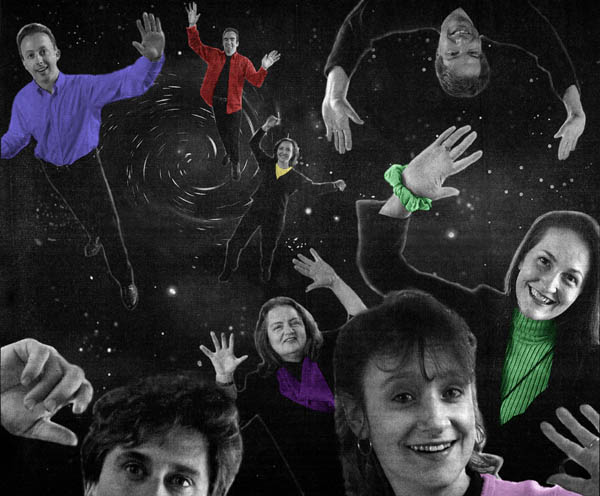
A group of scientists and computer professionals are using music to teach the wonders of the universe
by Lisa R. Rhodes
Special to The Gazette
"Wow!" Brandon says, eyes wide.
A few minutes later, Brandon hears the harmonies and melodies of several voices singing an upbeat pop song about radio frequencies. Suddenly, red laser lights dance across the midnight sky as one can hear the astonished gasps of other children in the room.
One anticipates seeing Spock from "Star Trek" beam down from the sky, but instead the audience is held spellbound by the music of the Chromatics, an eclectic seven member a cappella singing group, at a recent concert at the Montgomery College Planetarium in Takoma Park.
The Chromatics are a group scientists and computer and business professionals who have dedicated themselves to using music to educate children and families about the wonders of the universe.
"Kids are really into astronomy. They find it fascinating," says Karen Smale, a Web designer at NASA's Goddard Space Flight Center and a resident of Gambrills. A member of the Chromatics for nine years, Smale also designed the group's Web site. "Everyone wants to be an astronaut. We want to marry our love of music with kids' natural affinity toward space."
The Chromatics call themselves a group of "techies" who write and perform songs about outer space, the Internet, television and other manifestations of technology. At the concert in Takoma Park, the group performed songs ranging in subject matter from meteorites, pulsars, black holes and the Hubble space telescope, to gamma rays, the sun, the moon, asteroids and a Greek philosopher named Heroclitus, who believed stars and humans are made from the same life force. The group also performed "Tomorrow Never Knows," a song originally recorded by the Beatles.
"We want to take what many consider to be a not so interesting subject - science - and make it interesting to kids," says Deb Nixon, a computer systems administrator at a law firm, a Greenbelt resident and a member of the group for seven years. "Our educational concept is very important to us."
The Chromatics have released three CDs of original and cover songs, but the group is best known for "AstroCappella," a CD released in 1998 that is targeted specifically for use in the classroom. The CD was made as a result of a $6,000 educational grant awarded by NASA to the group to produce six songs about astronomy.
The grant is part of NASA's Initiative to Develop Education through Astronomy (IDEA). The group's members wrote original songs for the CD and collaborated with Kara Granger, a former Prince George's County middle school teacher, to write a supplementary curriculum to help teachers use the CD in the classroom.

"We have such a unique product, it sets us apart," says Lisa Kelleher
(right), harmonizing with Karen Smale.


Alan Smale sings lead during a Chromatics show Saturday in Ridgely, Md. "I like it when I see people moving in their seats," says Smale.
"'AstroCappella' comes in part from the concept of 'School House Rock,' the Saturday morning television show many of us grew up on," says Padi Boyd, an astrophysicist at NASA's Goddard Space Flight Center, a Greenbelt resident, the group's musical director and a member for nine years.
Boyd says just as her generation learned the preamble of the Constitution through the melodic songs of "School House Rock," the Chromatics compose "catchy tunes for fun for teachers and students'' to spread the word about astronomy. Ten thousand copies of the first "AstroCappella" CD were distributed for free to educators in the U.S. and abroad.
The idea for the a cappella singing group originated at NASA's Goddard Space Flight Center in 1993 when the members of the center's music and drama club wanted to form a holiday chorus. A singing group called the OK Chorale was formed and the group performed at Children's National Medical Center for Christmas.
The group performed mostly classical and chorale music. As time passed, several members left and new ones joined. The group evolved into the Chromatics (named after the chromatic spectrum in science - the way light is separated into different colors - and the chromatic scale of half notes in music), performing original compositions as well as pop and rock songs.
Today the group, which has appeared at the Kennedy Center's Millennium Stage and the Greenbelt Art Center, also performs songs by pop artists such as Abba, Paula Cole, and Sting. The Chromatics also have performed the national anthem for the Baltimore Orioles.
"I love to sing and perform," says Alan Smale, a scientist and researcher at NASA's Goddard Space Flight Center, Karen Smale's husband, the group's business manager and one of its songwriters. "I like it when I see people moving in their seats [to the music.] I hope they are entertained." Smale joined the group in 1994 after his wife joined.
"I guess we're crossover nerds," says John Meyer, a satellite power systems engineering technician at John Hopkins University's Applied Physics Laboratory in Laurel. Meyer, a Westminster resident, songwriter and a member of the group for six years, says he hopes the Chromatics' finger-snapping harmonies, lively choreography and colorful wardrobe help to dispel stereotypes about the "anti-social scientist."
Perhaps particularly to young people.
"I want kids to know that singing and science are not nerdy or sissy things. They're cool."
Paul Kolb, a furniture buyer in Beltsville, a resident of Ellicott City and a member for seven years, says the group uses humor to help audiences feel at ease with the scientific nature of some of their music.
"We have a lot of brain power and humor in this group," he says. "The humor helps people see that learning these kinds of detailed and specific subjects can have relevance in their lives."
Kolb, who met Karen and Alan Smale in 1995 when he joined the music and drama club's orchestra at Goddard as a clarinet player, says the Chromatics' music can complement the music young people hear on the radio.
"We never thought about getting kids away from contemporary music," he explains. "Any interest in any kind of music helps."
The Chromatics may not intend to break stereotypes of nerdy scientists or science as a boring subject, but the fact that the group includes a female astrophysicist can inspire girls and young people of color to view the sciences as a field that is open to everyone - not just white males.
"The field is changing," says Alan Smale, noting that graduate schools are now more likely to enroll women and members of other diverse groups. "We're [scientists] not just a bunch of older white men in lab coats. This is an increasingly outdated stereotype."
Lisa Kelleher, a budget analyst at NASA's Goddard Space Flight Center, a resident of Ellicott City, the group's bookkeeper, and a member for eight years, says the group's scientific and educational focus helps to distinguish it from other a cappella singing groups.
"We have such a unique product, it sets us apart," says Kelleher, noting that in the future she hopes the Chromatics become more established in performance venues in the Baltimore-Washington area. "Our music is like hearing a jingle on the radio that you can't get out of your head."
For additional information on the Chromatics' CDs and schedule, go to
www.thechromatics.com or www.astrocappella.com.